How Sentinel fits into your environment.

The diagram below shows the complete flow from a user reporting a suspicious email to the structured analysis being returned.
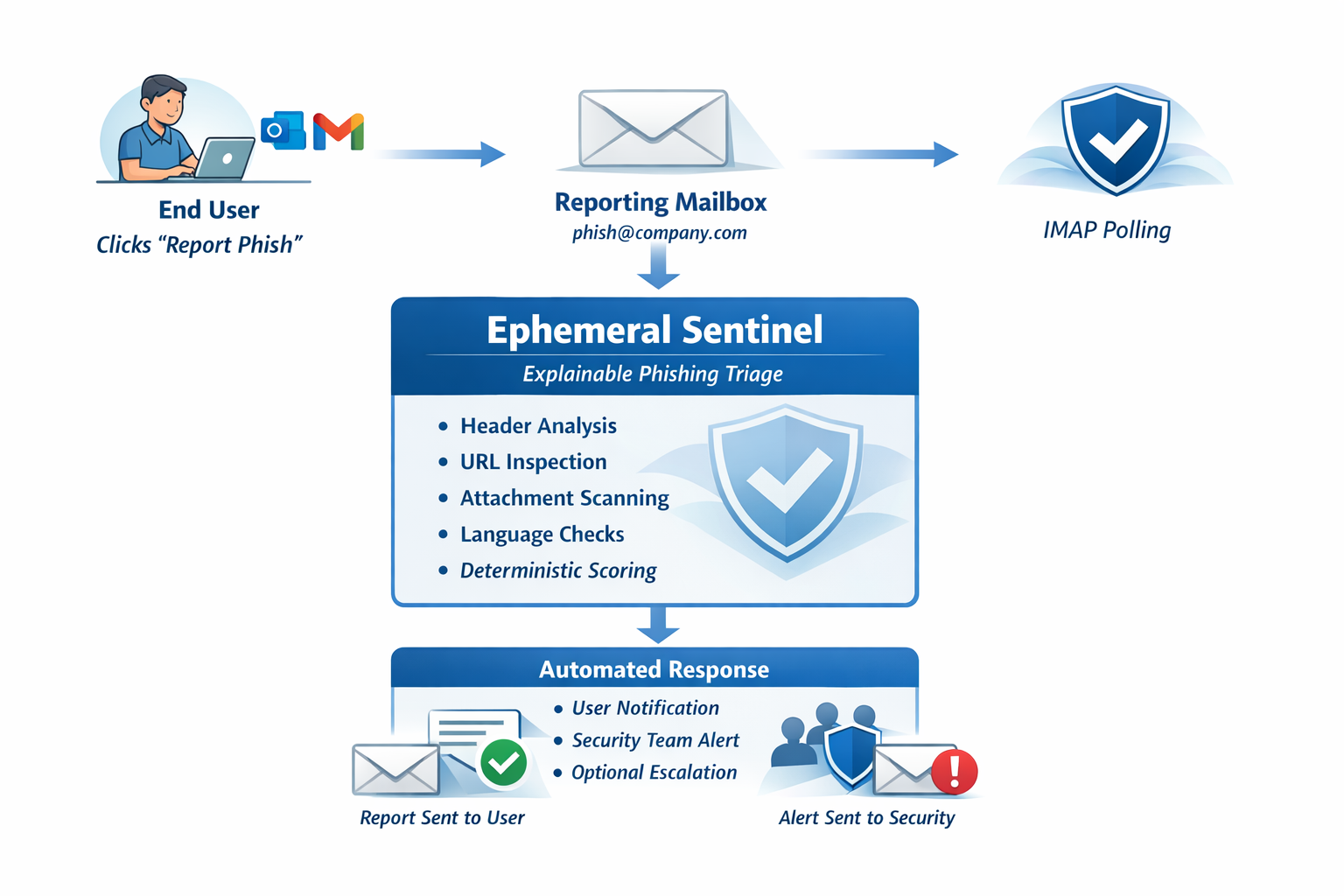
Ephemeral Sentinel architecture diagram: user reports email via Report Phish, email forwarded to reporting mailbox, Sentinel polls via IMAP, analysis performed locally, report returned to user and security team

Step by step.

Every phishing report follows the same path — from the employee's inbox to a structured analysis returned in seconds.

1
User clicks Report Phish
Available in Outlook (via the native Report Message add-in or a custom button), Gmail, or any email client configured to forward suspicious emails. The original message is attached as a .eml file.
2
Email arrives in reporting mailbox
The forwarded message lands in a dedicated reporting mailbox — typically something like phishing@yourdomain.com. This is a standard mailbox that already exists in most environments using a phishing report button. No new mailbox infrastructure required.
3
Sentinel polls mailbox via IMAP
Ephemeral Sentinel connects to the reporting mailbox via IMAP on a configurable polling interval. This is an outbound-only connection from the container to the mail server. No inbound ports are required on Sentinel's host. Compatible with Microsoft 365, Google Workspace, and self-hosted mail servers.
4
Analysis engine inspects the message
The attached .eml is parsed and loaded into memory. The deterministic analysis engine evaluates: email headers and routing path, SPF / DKIM / DMARC authentication results, sender domain characteristics, phishing language indicators, embedded URLs, and attachment file types. All analysis is local — no content leaves the environment.
5
Structured report generated
Analysis produces a weighted risk score (Benign / Suspicious / Malicious), a list of detected signals, an attack type classification, a plain-language attack narrative, and a recommended action.
6
Report returned, email content discarded
The structured report is sent back to the user who reported the email and optionally copied to the security team. The original email content is discarded from memory. It is never written to disk and never retained. Report metadata (timestamp, risk score, detected signals) is logged to a local SQLite database for audit purposes.

Every decision was made with security in mind.

Ephemeral Sentinel was designed to be a low-risk addition to any environment. These principles guided every architectural choice.

🚫
No Inbound Ports
Sentinel initiates all connections outbound. Nothing reaches in from the network. There is no listening port to expose, no service to scan, and no inbound attack surface to defend.
📡
IMAP Polling Model
The polling model requires only standard IMAP access to a single mailbox. This is trivially compatible with every enterprise firewall and mail server configuration. No webhooks. No inbound API endpoints.
💨
Ephemeral Processing
Email content exists in memory only for the duration of the analysis. Once the report is generated, the message is released from memory. Nothing is written to a file, database, or log. Only report metadata is persisted.
🏠
No External API Calls
Analysis is entirely self-contained. No reputation lookups, no cloud-based detonation, no third-party enrichment services. Email content stays inside the environment at all times.
🤖
No AI Dependencies
The analysis engine uses deterministic rule-based logic. No large language models. No inference APIs. No training data requirements. Results are consistent, reproducible, and explainable without probabilistic reasoning.
📦
Container Isolation
Sentinel runs inside a Docker container, providing process isolation from the host system. Deployment is repeatable and environment-independent.

What you're deploying.

Sentinel is designed to be lightweight and easy to understand. No complex dependencies. No black boxes.

Component Details
Deployment Docker container. Runs on any container-capable host.
Mailbox Connectivity Outbound IMAP (port 993 / TLS). Compatible with M365, Google Workspace, self-hosted.
Inbound Ports None required.
Analysis Engine Deterministic rule-based. No ML model. No AI API.
Email Retention None. Email content processed in memory and discarded.
Persistence SQLite — report metadata only (timestamp, risk score, signal list). No email content.
External Calls None. All analysis is local.
Report Delivery Email reply to reporting user. Optional CC to security team address.
Analysis Coverage Headers, SPF/DKIM/DMARC, domain signals, language patterns, URLs, attachments.
Risk Output Benign / Suspicious / Malicious — with weighted signal scoring.

What Sentinel inspects.

Eight analysis modules run against every reported email. Each contributes to the final risk score and report.

📨
Header Analysis
Parses the full email header chain to trace the true routing path from origin to inbox. Identifies relay anomalies and header manipulation.
🔐
Authentication Signals
Evaluates SPF, DKIM, and DMARC results. Pass/fail/neutral status for each protocol, with plain-language explanation of what each result means.
🌐
Domain Evaluation
Assesses sender domain age, registration pattern, top-level domain abuse reputation, and indicators of machine-generated naming schemes.
🗣️
Phishing Language Detection
Identifies urgency signals, impersonation markers, financial triggers, and social engineering patterns in the email body.
🔗
URL Inspection
Analyzes embedded links for redirect chains, mismatched display text, suspicious URL structure, and patterns associated with phishing infrastructure.
📎
Attachment Evaluation
Flags suspicious file types, unusual encoding patterns, and attachment characteristics associated with malware delivery campaigns.
📊
Deterministic Risk Scoring
Weighted scoring across all signal categories produces a clear risk verdict: Benign, Suspicious, or Malicious. Score is transparent and auditable.
📝
Attack Narrative
Plain-language description of the detected attack technique — written to be understood by users without a security background.

See what the output looks like.

Review the example report to see a complete Sentinel analysis, or explore the pages tailored to your specific context.

Ephemeral Sentinel is available for pilot deployments with MSPs and organizations that want to improve phishing reporting workflows.

Discuss a Pilot